
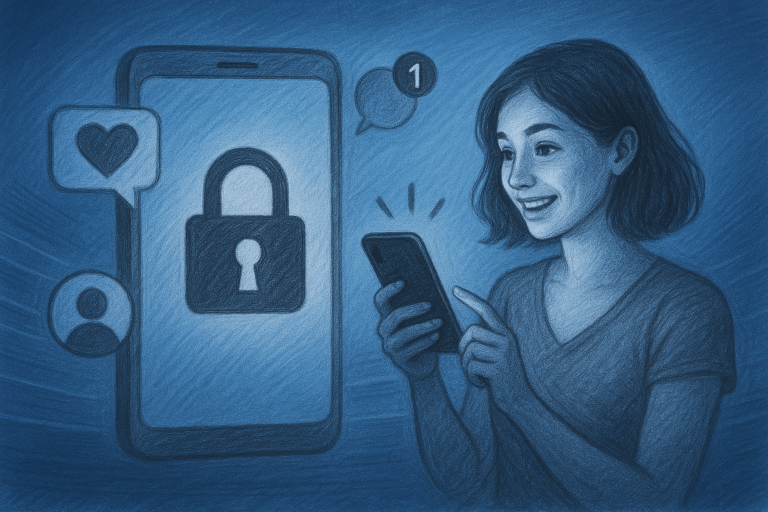
Online dating can be an enjoyable way to meet people, exchange ideas, and build meaningful relationships, but it also requires thoughtful digital boundaries. Many daters—especially women who receive frequent messages or unwanted attention—are told that online safety means either trusting everyone immediately or avoiding digital connections altogether. Both assumptions are misleading. A safer approach is practical, gradual, and based on controlling what information you share, when you share it, and how easily others can reach you. One useful tool is a secure second phone number, which creates a layer between your private communications and your online dating activity. This article explains common misconceptions through a before-and-after analysis, showing how small changes can improve privacy without making dating feel unnecessarily complicated. The goal is not to create fear or suspicion, but to help you make informed decisions while remaining open to positive experiences.
Before: Treating a Dating-App Number Like a Personal Number
A common starting point is to use the phone number already connected to your personal life. It may be the number used by family members, healthcare providers, employers, financial institutions, and long-term friends. When a new dating connection asks for a number, sharing that familiar contact can feel efficient. The conversation moves from the dating platform to text messaging, and the interaction appears to become more personal.
However, this convenience can create unnecessary exposure. A personal phone number may be associated with social-media accounts, old public listings, messaging apps, professional profiles, or data-broker records. Even when you have not deliberately published it, the number may help someone discover additional information about you. The problem is not that every new contact will misuse the information. Most people may behave respectfully. The issue is that you cannot always know a person’s intentions, technical knowledge, or persistence after a relationship ends.
Another misconception is that moving quickly to ordinary text messaging demonstrates trust. In reality, communication speed and trust are separate matters. A person can be pleasant, consistent, and interesting while you are still deciding how much personal information to disclose. Healthy boundaries do not signal hostility; they indicate that you value your privacy and expect others to respect it.
After: Creating a Communication Layer
A safer arrangement separates dating communication from your established personal communications. Instead of immediately distributing your everyday number, you can use a secure second phone number for early conversations, scheduling, and initial calls. This number becomes a communication layer: it lets you remain reachable without giving a new acquaintance direct access to the number connected to the rest of your life.
This approach is particularly useful when you want to move a conversation away from a dating platform but are not ready to share more identifying information. You can communicate by call or message, observe how the person behaves, and decide later whether the connection deserves greater access. If the interaction becomes uncomfortable, you have a clearer way to end contact or change the communication channel without disrupting important personal relationships.
The improvement is not merely technical. It supports a gradual model of trust. Before the change, sharing a number may unintentionally create a sense that the relationship has advanced further than it has. After the change, the communication channel reflects the actual stage of the relationship: open enough for conversation, limited enough to preserve choice.
Misconception One: “A Second Number Means I Am Being Secretive”
Some online daters worry that using an additional number will appear suspicious. They may fear that a match will interpret privacy as dishonesty, emotional distance, or a lack of genuine interest. This concern often comes from the mistaken belief that intimacy requires immediate access to every part of a person’s life.
Privacy and secrecy are not equivalent. Secrecy involves deliberately concealing information that another person has a legitimate reason to know. Privacy is the ability to decide when, how, and with whom personal information is shared. During the early stages of online dating, a new contact does not automatically have a legitimate claim to your home address, workplace details, family information, or primary telephone number.
A calm explanation can make the boundary easy to understand. You might say, “I use a separate number when I am getting to know someone online. It helps me manage privacy, and I hope you understand.” A respectful person will usually recognize this as a reasonable precaution. If someone becomes angry, mocks the boundary, demands immediate access to your personal number, or argues that privacy proves you are untrustworthy, that reaction provides useful information about their attitude toward consent and autonomy.
In the before state, you may feel pressure to prove your sincerity by surrendering information. In the after state, sincerity is demonstrated through honest conversation, consistency, and mutual respect—not unrestricted access.
Misconception Two: “Safety Tools Are Only for People Who Have Had a Bad Experience”
Another common misconception is that privacy tools are necessary only after harassment, stalking, fraud, or an abusive relationship. This is similar to believing that a seat belt is needed only after a collision. Preventive measures are most effective when adopted before a problem occurs.
Online dating involves uncertainty because profiles and conversations provide incomplete information. A person can present themselves as kind, successful, and compatible while still being difficult to evaluate fully. This does not mean that every match is dangerous. It means that a reasonable safety plan should account for uncertainty rather than relying on optimistic assumptions.
Using a separate number does not imply that you expect the worst from everyone. It simply acknowledges that early dating is an information-gathering period. You are learning whether a person respects boundaries, communicates honestly, and behaves consistently. A limited communication channel gives you room to learn without exposing your entire digital identity at the beginning.
Before adopting a preventive habit, you may wait until a situation feels alarming. After adopting it, privacy becomes routine rather than reactive. That distinction matters. A calm, ordinary safety practice is easier to maintain than an emergency response created under pressure.
Misconception Three: “Meeting in Person Makes Digital Privacy Irrelevant”
Some daters assume that once they have met someone face to face, online safety is no longer important. An in-person meeting can provide valuable context, but it does not eliminate the need for digital boundaries. A pleasant first date does not establish a person’s long-term intentions, emotional maturity, or behavior after rejection.
Digital contact may continue long after the date. Messages can be forwarded, screenshots can be saved, and contact details can be connected with other accounts. If the relationship does not continue, a person who has your personal number may still be able to call repeatedly, search for you through linked services, or contact you through other platforms. A separate number does not prevent every form of unwanted contact, but it can reduce the consequences of sharing contact information too early.
Before the change, an enjoyable meeting may lead to rapid access to your personal communication network. After the change, you can enjoy the date while preserving the option to evaluate the relationship gradually. The two goals are compatible. You can be warm, curious, and engaged while maintaining sensible limits.
Misconception Four: “A Different Number Guarantees Complete Anonymity”
It is equally important not to overstate what a second number can do. A separate number is a privacy tool, not an invisibility cloak. Depending on the service, account settings, platform features, and information you share, a number may still be connected to an account or identifiable through other clues. A person can also learn about you from your photographs, usernames, workplace references, location details, or social-media activity.
The correct before-and-after comparison is therefore not “unprotected” versus “completely anonymous.” It is “one exposed channel” versus “a more controlled channel.” A second number can limit direct access to your primary communications, but it should be used alongside other digital safety practices.
Review the privacy settings associated with the number and understand how calls, messages, voicemail, contact discovery, and account recovery work. Avoid assuming that a service automatically hides every detail. Read its current terms and privacy information, and choose a provider whose features and policies match your needs. The more sensitive your circumstances, the more carefully you should evaluate the service before relying on it.
How to Set Up Your Dating Communication Plan
Begin by identifying what you want to protect. Your personal number may be connected to relatives, colleagues, clients, medical services, banking alerts, and accounts that use text messages for authentication. The objective is not simply to obtain another number; it is to prevent early dating contacts from entering the communication channel that supports these essential relationships and services.
Next, select a reputable service that provides a separate number and the controls you need. Consider whether it supports calls and text messages, whether you can block contacts, whether it offers voicemail controls, and whether you can change or remove the number if necessary. Review the service’s privacy practices and account-security options. Use a strong, unique password for the account, and enable multi-factor authentication when it is available.
Then decide when you will use the number. Some people use it only after several conversations on a dating platform. Others use it before arranging a first meeting. There is no universal timetable. The important principle is that you should not be pressured into changing channels before you are comfortable. A match who wants to communicate respectfully can usually work within a reasonable boundary.
Prepare a simple explanation in advance. For example: “I prefer to use a separate number while getting to know someone. I am happy to talk, but I keep my personal number private at first.” Having prepared language makes it easier to maintain the boundary when a conversation becomes emotionally exciting or when a match applies pressure.
How to Share Information Gradually
Digital safety is strongest when treated as a process rather than a single decision. Information can be shared in stages according to demonstrated trust. Early conversations might include general interests, hobbies, cultural preferences, and broad descriptions of your work or neighborhood. More identifying details can wait until you have observed consistency and respect.
Be cautious with combinations of information. A workplace name, a distinctive job title, a photograph outside your home, and a description of your usual schedule may seem harmless separately. Together, they can reveal where you spend time and how someone might locate you. Similarly, mentioning a unique community group, child’s school, gym, or regular café can make your routine easier to identify.
Before sharing a social-media profile, check what a new visitor can see. Remove or limit public posts that display your address, travel plans, family members, daily routines, or other personal details. Search your own name and phone number periodically to understand what information may be publicly available. This is not an invitation to become obsessive; it is a practical audit of your digital footprint.
After adopting gradual disclosure, online dating becomes less dependent on a single moment of judgment. Instead of asking, “Do I trust this person completely?” you can ask more manageable questions: “Have they respected my boundaries?” “Are their stories consistent?” “Do they accept a slower pace?” “Do they respond appropriately when I say no?” These questions support a more evidence-based assessment.
How to Recognize Pressure Around Contact Information
Requests for a personal number are not automatically suspicious. Many people prefer texting or calling because it feels more convenient than using an app. The key issue is not the request itself but the reaction to your answer.
A healthy response sounds like, “That makes sense—use whatever you are comfortable with.” An unhealthy response may include guilt, ridicule, repeated demands, accusations, or claims that a “real” connection requires immediate access. A person may also try to make the decision seem urgent by saying they dislike the dating app, need to reach you immediately, or will stop talking unless you provide your main number.
Before, you may interpret pressure as evidence that the other person is especially interested. After, you can interpret it as information about their respect for boundaries. Interest is not a reason to disregard your comfort. Someone who is genuinely compatible will understand that trust is built through repeated behavior, not extracted through demands.
How to Use Calls and Messages More Safely
When using a second number, apply the same caution you would use on any digital channel. Avoid sharing verification codes, passwords, financial information, copies of identification documents, or private images in response to a new contact’s request. A phone conversation can feel personal, but voice familiarity does not prove identity.
Be attentive to requests involving money, gift cards, cryptocurrency, loans, travel expenses, emergency assistance, or payment for a supposed business opportunity. Romance scammers often build emotional closeness before presenting a financial problem. A separate number may help protect your primary contact information, but it cannot substitute for skepticism about financial requests. Never let emotional urgency replace independent verification.
Consider disabling message previews on your lock screen if your phone is shared or visible in public. Keep the application updated, use device security features, and review which permissions it requests. If a service allows you to restrict contact discovery or hide profile information, enable those settings according to your preferences.
Maintain records of unwanted or threatening messages. Do not engage in prolonged arguments with someone who is harassing you. Use blocking and reporting tools, and tell a trusted person if the behavior concerns you. If you believe there is an immediate danger, contact local emergency services or an appropriate support organization.
Before and After: Ending an Uncomfortable Conversation
Ending contact can be difficult because many people want to be polite. They may continue replying long after they have lost interest, hoping to avoid offending the other person. Yet a clear ending is often kinder and safer than an uncertain exchange that invites continued negotiation.
Before using a separate number, ending a conversation may require changing your personal number or tolerating repeated calls on the device used by family and work contacts. The practical cost can make people delay action. After using a separate number, you may have more options: send one clear message, stop responding, block the contact, or replace the secondary number if the service permits it. You still need to use judgment, but the boundary is easier to enforce.
A concise message might be: “I do not think we are a match, so I am ending contact. I wish you well.” You do not owe a lengthy explanation. If the person responds with anger, bargaining, insults, or threats, avoid trying to persuade them. Save the relevant messages, block them, and seek support if needed.
How to Balance Privacy With Authenticity
Some people worry that safety practices will make them seem guarded or prevent genuine connection. This concern deserves a thoughtful response. Authenticity does not require immediate disclosure of every personal detail. You can express your personality, values, humor, curiosity, and affection while still choosing not to reveal information that could identify or locate you.
In fact, clear privacy practices can encourage more authentic interaction. When you are not worried about exposing your primary contact details, you may feel more comfortable asking meaningful questions, stating your preferences, and ending conversations that do not feel right. A boundary can reduce the pressure to perform constant availability or accept behavior that makes you uneasy.
The before state often confuses openness with access. The after state distinguishes them. Openness is emotional and conversational honesty. Access is permission to reach particular parts of your life. You can offer the first without automatically granting the second.
A Practical Before-and-After Checklist
Before: You use your everyday number because it is convenient, assume a friendly profile represents a trustworthy person, and share identifying details as the conversation becomes exciting. You may interpret questions about privacy as a challenge to prove your interest. If the interaction becomes uncomfortable, changing your number feels disruptive.
After: You use a separate communication channel while trust develops, review the relevant privacy settings, and share personal details gradually. You evaluate a match by behavior over time, including their response to boundaries. If the connection ends poorly, you can block or replace the secondary channel without interfering with essential personal communications.
To put this into practice, complete the following steps:
1. Audit your primary number. Consider which accounts, relationships, and services are connected to it. This helps you understand why protecting it matters.
2. Choose a suitable secondary service. Compare features, privacy policies, account protections, call controls, messaging functions, and the ability to block or change numbers.
3. Establish a personal rule. Decide when you will move from a dating platform to another channel and what information you will not share during the early stages.
4. Explain the boundary confidently. Use brief, neutral language. You do not need to apologize for protecting your privacy.
5. Review your digital footprint. Check public profiles, usernames, photographs, and search results for information that could reveal your home, workplace, routine, or family connections.
6. Monitor behavior, not promises. Trust should reflect consistent actions. Respect, patience, honesty, and acceptance of “no” are more meaningful than intense declarations made early.
7. Prepare an exit plan. Know how to block a contact, report inappropriate behavior, preserve evidence, and ask trusted people for help.
Why This Approach Supports Better Decisions
The academic principle behind this strategy is risk reduction through layered controls. No single measure can eliminate every digital threat. Instead, several modest protections can reduce the likelihood and impact of a problem. A separate number limits exposure. Strong account security protects access. Careful disclosure reduces identifying clues. Public meeting practices support physical safety. Blocking and reporting tools help manage unwanted contact.
This layered approach also improves decision quality. Online dating can create a phenomenon sometimes described as accelerated intimacy: frequent messages and emotional disclosure produce a sense of closeness before the people involved have developed a reliable understanding of one another. A communication boundary introduces a small amount of structure into that process. It gives you time to compare words with actions.
For women navigating online dating, this structure can be especially empowering when cultural expectations encourage constant availability or politeness. You are not required to answer every message, provide a personal number, explain a refusal, or continue a conversation to protect someone else’s feelings. Safety and courtesy are compatible, but courtesy should never require surrendering autonomy.
Conclusion: Make Privacy a Normal Part of Dating
The most useful change is not from fear to suspicion; it is from automatic access to intentional access. Before, many online daters share their personal number because doing so seems like the natural next step. After, they use a secure second phone number as one layer in a broader, evidence-based approach to privacy. This practice does not guarantee anonymity, identify every dishonest person, or replace good judgment, but it can provide flexibility while trust develops. By moving gradually, reviewing your digital footprint, recognizing pressure, and preparing a clear exit plan, you can protect your boundaries without closing yourself off from meaningful connection. Get started today by reviewing your communication habits and choosing the privacy tools that help you date with greater confidence, control, and peace of mind.